Index:
1. Abstract
2. Introducing Schrodinger’s cat
3. Quantum superposition - The cat was alive “and” dead
4. Quantum measurement - How curiosity kills the cat
5. Quantum entanglement - The cat is in superposition, so the box is in superposition
6. The Many Worlds interpretation
7. Conclusion
Abstract:
This project aims to explain the mind-bending basics of quantum mechanics, in simpler terms. Fields like quantum mechanics can seem very intimidating so people often get confused but it’s always best to remember all along that you’re not making any conclusions, you’re just exploring. That can help you keep an open mind and understand various concepts.
The material for this project has been taken from books, websites, and documentaries, and collected in diagrammatic, tabular, and written form. This project briefly talks about the derivation of the experiment and its purpose. Most essentially, it explains the three basic concepts in quantum mechanics i.e. Quantum Superposition, Quantum Measurement, and Quantum entanglement, but it also explores a few other interpretations such as the “Many Worlds interpretation” and the “Von-Neumann Wigner interpretation”.
Introducing Schrodinger’s cat:
Erwin Schrodinger once imagined putting a cat in a sealed box with a device that has a 50% chance of killing the cat within one hour, and at the end of that hour, he asked, “What is the state of the cat?”. Now, according to common sense, we can only say that the cat will be alive “or” dead, but Schrodinger pointed out that according to the Copenhagen interpretation of quantum mechanics, right before the box is opened the cat is both alive “and” dead, which sounded absurd, even to himself. In fact, he had found this thought so disturbing that he abandoned the field and started working in biology instead.
However, others didn’t let this opportunity go unnoticed, this thought experiment was claimed to be tangible, at least in the field of quantum mechanics.
It was termed as the “Schrodinger’s cat” thought experiment and this project looks at various prospects of it, through which we also learn some basic concepts in quantum mechanics.
However, the cat is dead “and” alive only before observation, the instant the box is opened to observe i.e. an external system interacts with our pre-existing system, the cat’s state becomes either dead “or” alive.
This is a thought experiment devised by the quantum physicist, Erwin Schrodinger and there’s a good chance that you have heard of it as an extract of quantum mechanics conveying how confusing or interesting it is. But, in fact, this thought experiment was devised to oppose the understanding of quantum mechanics at the time. Erwin Schrodinger had thought of this idea to show people how the understanding of quantum mechanics at that time i.e. the Copenhagen interpretation- if we can be a little complacent- did not make any sense! Schrodinger wanted to show people how misinterpretations of quantum theory could lead to absurd results which do not match how the real world works.
However, nowadays, the most widely accepted interpretation of quantum mechanics is the Copenhagen interpretation, and Schrodinger’s cat has become a way of understanding the basics of this interpretation. In fact, a very essential phenomenon of the quantum world is very simply (comparatively) explained by this thought experiment, and to begin with, let’s try to understand what exactly happens in this thought experiment and observe its details.
Schrodinger’s cat - the thought experiment:
The original thought experiment goes something like this: you take a cat and you put it in a steel box that is completely isolated from the real world. The box contains a radioactive atom with an equal probability of decaying and not decaying within one hour. Within the box, you also have a Geiger counter, which detects radiation i.e. it can detect if the atom has decayed or not. The Geiger counter is connected to a hammer which is near a glass container of poison. If the atom decays and the Geiger counter detects it, the hammer will hit the glass container with poison and the poison will get released, in turn, killing the cat. But, if the atom does not decay, the Geiger counter will not detect radiation and the hammer will not hit the glass container of poison, and our cat gets to live.
For the legitimacy of the thought experiment, Schrodinger notes that the system of the radioactive atom, the Geiger counter, the hammer, and the glass container of poisonous gas, must be secured from direct interference by the cat.
The thought experiment said that while the box is closed, there is no way of knowing if the cat is alive or dead because there is an equal probability of it being alive or dead, and according to the “Copenhagen interpretation” of quantum mechanics (which was formed at the Copenhagen university by a group of physicists actually, but it’s mainly attributed to Neils Bohr and Werner Heisenberg)- the cat is both alive and dead and once you open the box to observe or make a measurement-instead of minding your own business- the state of the cat randomly collapses to either dead or alive.
These are the details that are now known of the original thought experiment devised by Erwin Schrodinger in his letter to Einstein, and it’s quite likely that some things have been changed. Some people know of Einstein’s version of this thought experiment, where instead of a poisonous gas killing the cat (eventually), there’s a gunpowder bomb with a 50% chance of exploding within a minute, and the rest a chance of not exploding at all. However, the phenomenon being explored in either case is a very famous quantum phenomenon known as quantum superposition. Though it sounds like absurdity at its peak, it is considered one of the foundations of quantum mechanics today.
The cat was alive AND dead:
Imagine a sphere, with one of its hemispheres colored white and the other colored black. If you spin it and it stops randomly, there will always be some probability of observing the black side in front and some probability of it being observed the other way round, but you don’t know the accurate result unless you stop the sphere and observe. When it’s spinning, however, there are countless possibilities. It can have a 50% chance of stopping at black and a 50% chance of stopping at white, a 75% chance of stopping at black and a 25% chance of turning white, a 10% chance of stopping at black and a 90% chance of stopping at white, and so forth.
One really cannot be sure of the outcome during such a process, because while it is spinning, the sphere is in a different state known as the superposition. This state is like a mix (or a soup) of all possible outcomes that the sphere could result in, which here is-as mentioned earlier- either the white face front or the black face front. Hence, while spinning, the ball is in superposition and we see a mix of both the colours.
This phenomenon has made it beyond theory, as quantum superposition has been observed through the genius of the double-slit experiment. Thomas Young first conducted this experiment to support the idea of the wave model of light. He had passed light through a screen with two slits in it and on a screen beyond, an “interference pattern” was observed.
An interference pattern is when two waves meet, and the troughs of one cancels with the crests of the other or vice-versa (the darker bands shown below), or the troughs of one adds up with the troughs of the other and the crests add up with the other crests (the brighter bands shown below).
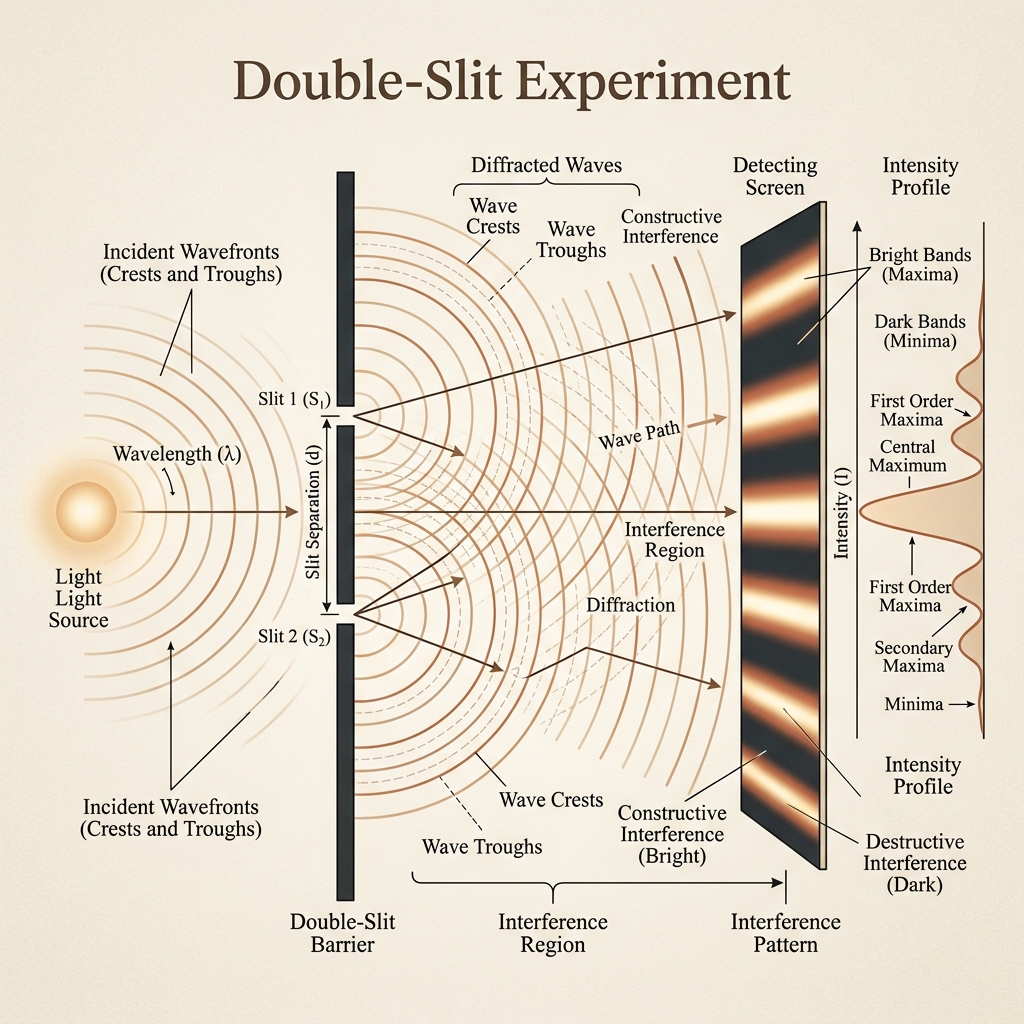
Later after it was proved that light was a particle and a wave, De Broglie proposed that other quantum particles must also behave in such a way. To prove his theory, he conducted the same experiment with a beam of electrons hitting the first screen (with two slits), instead of a beam of light.
The same wave interference pattern was observed on the screen beyond, hence proving the particle-wave duality of all quantum objects! So, this concludes that the wave state of electrons allows them to enter through both slits at the same time, which is a superposition of the two possible outcomes! Hence, proved that superposition is very real.
*Note - The top parts of waves are known as crests and the bottom parts as Troughs.
The core of quantum superposition lies in the concept of wave functions. Unlike physical waves in the real-physical world, waves in the quantum world are mathematical and they are expressed as so-called “Wave functions”.
A wave function describes the probability of a quantum object’s state and whereabouts such as energy levels, its position in space, and its trajectories. Wave functions are usually denoted by the symbol Ψ (psi) and they can look very complicated but the basic point of them is to find probabilities of possible outcomes.
They give us information on quantum objects in the form of waves of probability or what we call “probability amplitude”, which is the likelihood of finding a quantum object at a certain place if we were to look for it there. All you have to do is, square the numbers before each given state in the wave function.
For a simple example, let’s say we have a quantum object in superposition that can be observed in two possible states - A or B, a wave function for such a quantum object could look something like this:
Now if we want to find the probability of the quantum system being in state A we would have to square the number in front of it i.e. (1/√2)² = 1/2 or 50%. To find the probability of the system being in state B, we would do the same process i.e. (1/√2)² = ½ or 50%. Hence, we see that both are equal probabilities in this case. But, in quantum mechanics, these numbers that we’re squaring aren’t so simple. They aren’t even real- they’re complex i.e. a sum of real and imaginary numbers.
So that’s why, when we square them, we get a real number which we can then take as a probability for the given possible outcome. Interestingly, there’s also a special equation called the “Schrodinger equation”, ( You’re right! This was also one of Erwin Schrodinger’s creations)which was made to show us the evolution of a wave function mathematically. It describes how a quantum system will change through time.
Now we have a basic understanding of wave functions but how are they in any way related to quantum superposition? The point is that a superposition is another wave function that, when solved, gives us as many correct answers as the number of possible outcomes. To understand, let’s say, (x² = 9) is our “superposed wave equation”, then x = 3 or (-3). So, 3 and (-3) become the wave functions of the possible outcomes.
But we can only make use of one answer here, just like when observing any quantum system, its wave function collapses and we only get to see one of the possible outcomes! Though, unlike in this case, collapsing of the wave function upon observation is actually a property of quantum systems. And that’s why, if we were to observe Schrodinger's cat we would only see that it’s either dead OR alive. So eventually, our curiosity could kill the cat!
How curiosity kills the cat:
In physics, there is a field for big things like us, that we call “Classical mechanics”, and one for tiny particles like atoms, electrons, etc. that we call “Quantum mechanics”. In classical mechanics, things can’t be existing in a probability of properties like quantum systems, but they have to have clear and definite properties. For us (beings of the classical world) to observe, somewhere an exchange must happen from the ways of the quantum world to the ways of the classical world and that’s what we call measurement.
Only if the box is opened to observe, in the thought experiment, will we see that the radioactive atom has decayed and the cat is dead or that the radioactive atom has not decayed and the cat is not dead. This concept is known as the “collapse of the wave function” i.e. the superposed wave function collapses to just the wave function of one of the possible outcomes. This is all the information that the Copenhagen interpretation of quantum mechanics gives us about measurement.
There’s no mention of the observer or the object which observes. So according to the Copenhagen interpretation, the act of measurement somehow causes an evolving wave function to subside into another wave function (of one of its outcomes), irreversibly.
But there has to be more to it! -Is what John Von Neumann and Eugene Wigner thought as they tracked down the process of measurement in one of the experiments - the double-slit experiment. The process of measurement, they noted, goes like this, you hit one electron through the first screen and it hits somewhere on the detector screen. Then the electron which was hit on the detector screen excites another electron beyond it.
This new electron excites another and that excites the one next to it, and a chain goes on like an electrical impulse till your computer and your computer receives the signal and an image is shown on its screen (of the original electron’s position).
This information travels by photons to light-sensitive molecules in your eyes, which then send electrical signals to the visual cortex in your brain, and then you can finally observe the image of the electron’s chosen position on the detector screen of your double-slit experiment. This whole process is now known as the “Von Neumann chain”, and they said that the collapse of the wave function happens somewhere within this chain.
Neumann and Wigner also developed an interpretation of quantum mechanics (which is more like a subset of the Copenhagen interpretation) based on this concept of human consciousness causing a collapse of a superposed wave function. It is a theory known as the Von Neumann-Wigner interpretation, which goes a lot into human psychology and philosophy but further experiments need to be done to support it.
Wigner had also devised a thought experiment, which we can refer to as the “Wigner’s friend thought experiment” now. In this thought experiment, you don’t conduct the double-slit experiment but your friend does. You are aware that the experiment has been completed and measurement has been made of the electron’s position but you don’t know the result, only your friend does. In essence, for you, your friend’s mind exists in a superposition of all the possible outcomes of the experiment.
Once your friend tells you the results, will only the wave function collapse from your perspective. But, for the friend, the wave function had collapsed once the physical experiment had been conducted and observed. Therefore, it’s seen that different observers will see the same wave function collapse at different times. Wigner felt that a brain or a consciousness couldn't be in superposition, because once the outcome has been decided it cannot exist in probability anymore, so he had concluded that conscious first-hand experience must play a role in the collapse of a wave function. But again, this theory also needs further experimentation to be supported.
As it is an essential concept, Heisenberg also explored quantum measurement in his writing later on. He eventually said that the wave function collapse must be a continuous process between the measurement device and the conscious mind, instead of it just happening suddenly by the conscious mind.
There’s still no concrete answer to where and how the collapse of the wave function occurs. Hence, in quantum mechanics, we still don’t know what measurement is and that in itself is a concept being explored, it is known as the “measurement problem”.
Many physicists have tried exploring this problem through the von Neumann chain, and by relating the conscious mind to the act of measurement, but there can be many other ways to think about it. However, to be able to think about it, we need to understand another fundamental phenomenon in quantum mechanics. It could explain how we don’t even need to consider a measurement being made if we just put all the objects in one system!
The cat is in superposition, so the box’s in superposition:
Though entanglement is a quantum phenomenon, we can still show it in play in the classical world. Let’s say, you ask a shopkeeper to give you two pens packed in a box. The shopkeeper tells you that they only have two colors for pens in their shop i.e. Black pens and Blue pens. But the colour of the pen does not bother you, so you ask them to pack two random pens in a box and give them to you.
Now, there can only be four possible outcomes that you’d get if you opened the box - 1) A blue pen and A blue pen, 2) A black pen and a black pen, 3) A blue pen and a black pen, or 4) A black pen and a blue pen (which is honestly the same but let’s consider the arrangement important). Now, let’s say you were told that there are equal probabilities for each possible outcome. Then, if you were also told that one pen is blue, you would think of the outcome being (1) or (3), which still doesn’t accurately answer the question of figuring out the state of the other pen with only information from one pen.
However, if the shopkeeper told us that both the pens are of the same color, we would narrow down our possibilities and we could say, that there’s a 0% chance that we would get the outcomes (3) or (4), and 50%-50% probability that we would get outcomes (1) or (2). Hence, if we are told that one pen is blue, (by referring to outcome (1)) we can instantly tell that the other is also blue. This way, by knowing the information of one of the pens, we can immediately give information on the other i.e. we can say that the pens are entangled.
Quantum entanglement is quite similar to this, their wave functions have joined and become one wave function in such a way that when you measure one, you immediately get information on the state of the other too! Since before measuring, the particles were in a superposition, so if you only measure one particle i.e. collapse the wave function of it to get an outcome then you can instantly tell the outcome of the other particle.
This phenomenon will work even if the particles are lightyears apart because once entangled, the particles will remain as part of the same wave function forever! But what if the collapse of the wave function doesn’t even happen for us? What if we use entanglement to find a way around the measurement problem?
In Schrodinger’s cat thought experiment, can’t we just say that the radioactive atom, in a superposition of decayed and not decayed, is entangled with the cat in a superposition of dead and alive within the system of the box? So if we open the box, even we (eventually, we’re also just quantum particles), get entangled with this system in a superposition of observing the cat dead and observing the cat alive.
There is no collapse of the wave function, instead, we actually observe both the possible outcomes i.e. we see the cat dead and we also see the cat alive, but in different worlds! This is the “Many Worlds interpretation” of quantum mechanics and these days, it’s starting to make a lot of sense!
The Many Worlds Interpretation:
This interpretation uses concepts from the already known Copenhagen interpretation to build something new. A whole new concept of reality! The Many-worlds interpretation is based on something called environmental decoherence. In essence, that means the millions of particles like photons and air molecules that are in superposition when interacting with the environment get entangled with the environment. And the universe branches out into other universes depending on the number of possible outcomes that the particles could result in so that each outcome occurs but in different universes. So in Schrodinger's cat thought experiment, in our universe, if the cat is found alive, in another, it would be found dead!
This interpretation was devised by Hugh Everett, who noticed that according to the Copenhagen interpretation when evolving wave functions collapse a discontinuity is produced and the reason is not very clear so he proposed that instead of wave functions collapsing, why don’t we just think of the whole universe as one wave function, the observers and the quantum objects becoming parts of the same quantum system.
He said that at each interaction, the wave functions of the object, the observer, and everything around them in the quantum system would bifurcate, or spawn countless branches of the universe, each with different events occurring in them. Therefore, the universal wave function would contain as many alternatives as the number of states making up the superposition.
He also said that according to the Schrodinger equation, once evolved, the branches of the universe will not influence each other. They will move on, independent of each other i.e. they will have different futures.
Everett’s theory was merely thought of as a hypothesis by most scientists at that time. Still, in fact, he had used mathematics from quantum mechanics to form the interpretation in the first place, and it was accurate! Everett also didn’t exactly state the “multiverse” idea in his writing, it came as a product of his theory.
In fact, in a footnote, he had mentioned, “From the viewpoint of the theory, all elements of a superposition (all ‘branches’) are ‘actual,’ none any more ‘real’ than the rest.” But, in fact, by this interpretation, we can make sense of why we don’t ever see superpositions in our world. Well, because we only observe one outcome and other copies of ourselves in other worlds are observing the other possible outcomes.
Hence, for our Schrodinger’s cat thought experiment, we can use this interpretation and say that when the radioactive atom in the box came into a superposition of decayed or not decayed, the detector (which was connected to it) also came into a superposition of detecting radiation or not, so did the hammer, the cat and the observer, and if some particles like photons from the environment which were inside the box interacted with this quantum system- the quantum system environmentally decohered i.e. this system branched into another. And another version of you (which is not you anymore!)observed the cat dead, if you observed it alive.
Basically, according to this interpretation, every outcome is happening 100% of the time but we don’t see it because we can only experience the outcome in this universe of ours out of the (close to infinite) multiverses!
These interpretations of quantum mechanics can be thought of as different ways of looking at Schrodinger’s cat thought experiment itself.
The Copenhagen interpretation and all the concepts in it, and the Many Worlds interpretation i.e. the concepts explored in this project are still just theories and we can’t say which one is correct or even if either is correct, there can be many other interpretations. These two interpretations are the most well-known and supported ways of looking at it but there can be many and even you might find another if you completely understand the basic concept!
Conclusion:
In this paper, we learnt about how the Schordinger’s Cat was actually a thought experiment devised to oppose the theories of quantum mechanics present at the time by the famous physicist Erwin Schrodinger, though it became a phenomenal idea anchoring physicists to conduct further research into the field. It also explains the core concepts in Quantum physics such as the principle of superposition, entanglement and collapsing of wave functions. It mentions how the dual nature of matter is highlighted in quantum physics and how quantum physics allows us to think of an object as being in multiple states at one instant. We can describe everything using simple equations which also describe how the object evolves with time. In the end, we get to learn about the most well-known interpretations of quantum physics out there, to show how interesting and colourful this field is.
Throughout the process of writing this paper, I learnt that scientific discoveries whether they are theoretical or not begin with a single thought or a question. I found it quite interesting how quantum mechanics as a field of physics was born out of the various interpretations that scientists had on one intriguing thought experiment. Hence, I feel it is very important to keep questioning and communicating science to spread to the masses. Because at the end of the day, though quantum mechanics might be the most baffling field in physics out there, if explained well it can be understood by anyone and worked upon further. So it is important to stay curious and courageous to question even the firmest of theories out there for us to get more familiar with the universe and each other.
Bibliography
Hossenfelder, S. (no date) The Problem with Quantum Measurement, YouTube. Available at: https://youtu.be/Be3HlA_9968 (Accessed: 3rd May 2022).
Muller, D. (no date) Parallel Worlds Probably Exist. Here’s Why, YouTube. Available at: https://youtu.be/kTXTPe3wahc (Accessed: 3rd May 2022).
Merali, Z. (2024) This twist on Schrödinger’s Cat Paradox has major implications for quantum theory, Scientific American. Available at: https://www.scientificamerican.com/article/this-twist-on-schroedingers-cat-paradox-has-major-implications-for-quantum-theory/ (Accessed: 3 May 2022).
Faye, J. (2002) Copenhagen interpretation of Quantum Mechanics, Stanford Encyclopedia of Philosophy. Available at: https://plato.stanford.edu/entries/qm-copenhagen/ (Accessed: 3 May 2022).
Why is Schrodinger’s equation with Copenhagen interpretation an exceptional success? (no date) Quora. Available at: https://www.quora.com/Why-is-Schrodingers-equation-with-Copenhagen-interpretation-an-exceptional-success (Accessed: 3 May 2022).
Aziz, A. and Borg, M. (2024) Schrödinger wave equation: Derivation & explanation, Electrical4U. Available at: https://www.electrical4u.com/schrodinger-wave-equation/ (Accessed: 4 May 2022).
Schrödinger’s Cat: A thought experiment in quantum mechanics - Chad Orzel (2014) TED. Available at: https://ed.ted.com/lessons/schrodinger-s-cat-a-thought-experiment-in-quantum-mechanics-chad-orzel (Accessed: 4th May 2022)
What is superposition and why is it important? (no date) Caltech Science Exchange. Available at: https://scienceexchange.caltech.edu/topics/quantum-science-explained/quantum-superposition (Accessed: 4 May 2022).
Voorhoede, D. (no date) Superposition and entanglement, Quantum Inspire. Available at: https://www.quantum-inspire.com/kbase/superposition-and-entanglement/ (Accessed: 5 May 2022).
Mishra, N. (2021) Understanding basics of measurements in quantum computation, Medium. Available at: https://towardsdatascience.com/understanding-basics-of-measurements-in-quantum-computation-4c885879eba0 (Accessed: 5 May 2022).
Wilczek, F. (2019) Entanglement made simple, Quanta Magazine. Available at: https://www.quantamagazine.org/entanglement-made-simple-20160428/ (Accessed: 5 May 2022).
Byrne, P. (2024) The many worlds of Hugh Everett, Scientific American. Available at: https://www.scientificamerican.com/article/hugh-everett-biography/#:~:text=In%20Brief,different%20events%20occurring%20in%20each (Accessed: 5 May 2022).