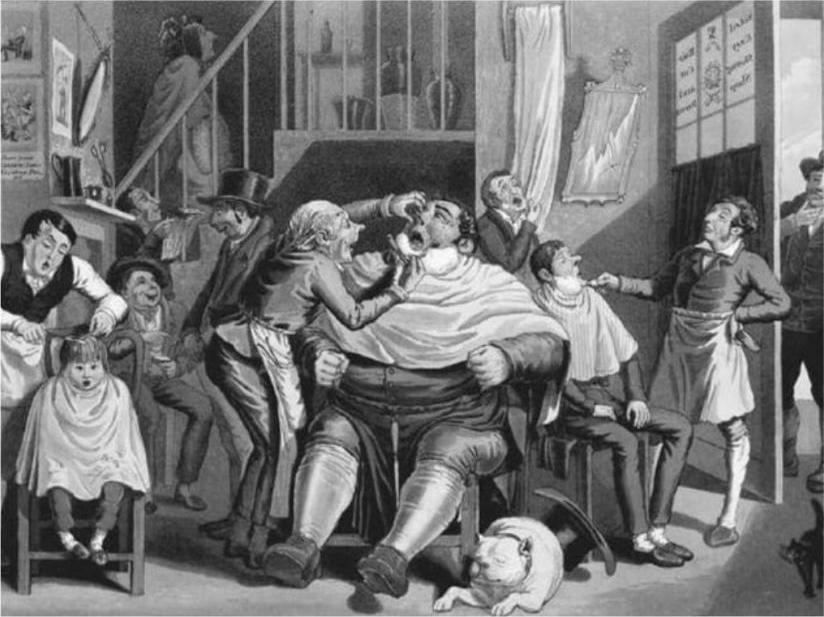
In the 1700s, Barber-Surgeons would treat those whom doctors would not. From tooth-pulling to blood-letting to lobotomies, the practice of 'dentistry' circumvented the boundaries of natural medical care to relieve patients with unconventional injuries. A headache might result in holes being drilled into one's skull, and as brutal as it sounds, this ancient method of 'surgery' laid the foundation for what we consider modern medicine.
Human advancement is dependent on the constant acquisition of new knowledge. This is in the benefit of not only academic communities, but the entirety of society, as propelled forward by newer technologies, historical narrative, and scientific development. We often disregard how much our lives are affected by the mechanisms upheld by the scholarly world - but newfound knowledge translates to newfound medicine, infrastructure and social systems.
Having established the importance of consistent investigation, we must recognise that the means by which knowledge is acquired may not always align with the prescribed moral obligations of a researcher.
Utilitarianism argues that all decisions should be taken in the best interest of a larger group; the standard “needs of the many, outweigh the needs of the few” approach. However, this raises a question on how far we are willing to go, to serve the needs of the many indeed. Every system within each area of knowledge differentially defines an 'ethical standard' - essentially creating discrepancies in the administration of higher research. Moreover, ethical standards change across time periods; while drilling holes into one's skull was an acceptable convention in the 1700s, the same could result in extreme social condemnation and perceivably weigh much heavier on your conscience (hopefully) today.
As a global community, we have developed mechanisms to test knowledge in simulations rather than in real life but even something as disengaged with human testing as space exploration can have its environmental ramifications. At every critical juncture in social development, the academic community makes an all-important decision on whether knowledge is worth the consequences raised by its acquisition itself. For example, in 2020, when the Coronavirus was first classified as a pandemic, the healthcare industry tested experimental vaccines on hundreds of subjects, at the expense of their health. In 1962, Stanley Milgram asked 40 people to give 40 others a shock with 450 volts of electricity, leading to major revelations about the psychology of conformity. Earlier still, Pavlov cut holes into his dog's throat to measure the movement of his gastric juices, to further test the root of cognitive conditioning.
One is prone to feeling some disillusionment with the ethical standards of experiments past, but we have built our knowledge systems on the substructures built by these infamous researchers. As we stand in the face of great social adversity even today, we must consider that historically, the world's need for mass exploration and research has always undercut ethical standards, and it may very well continue to do so in the future.
~ Aanya Chand